Ep 38: Heather Wright & Jane Considine on Amazing Books, Boosting Writing & Representing Female Teachers
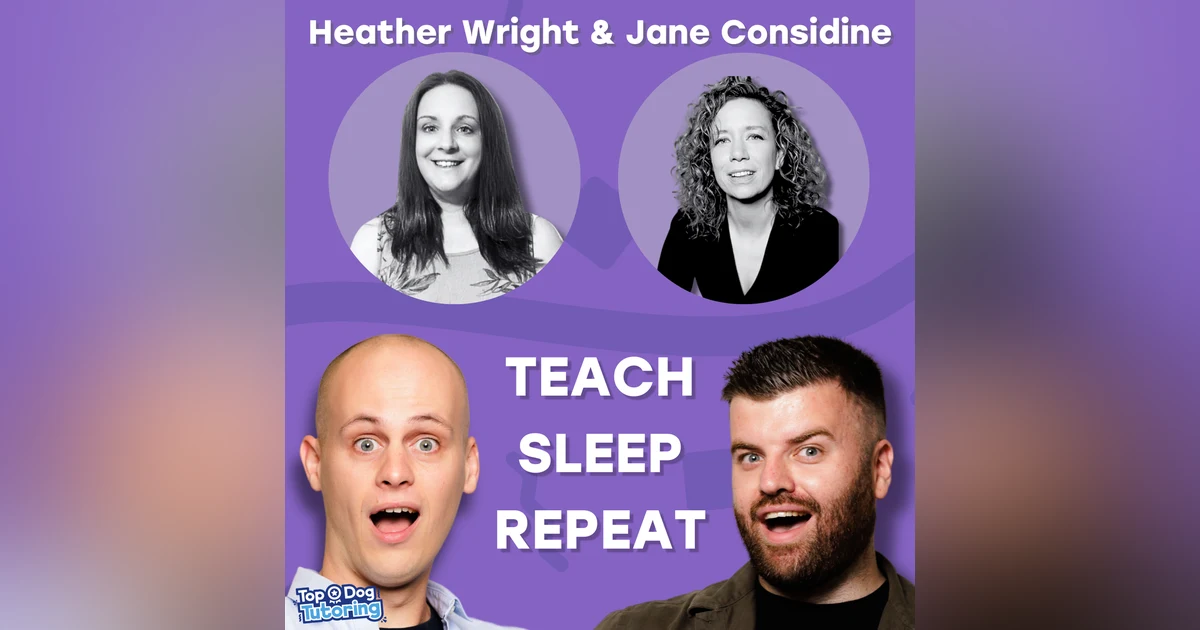


We are joined this week by two extremely knowledgeable and lovely guests: Heather Wright and Jane Considine.
Heather created and runs the amazing 'Reading Rocks' which provides amazing opportunities to children, from book deliveries to author events.
Jane is a widely respected and well-known provider of training around all things English. Her methods and practice is implemented in thousands of schools across the world.
Recently, they both delved into the podcasting world with their show 'The Teacher Squad Podcast'. If you enjoyed this episode, why not check them out on all major streaming platforms?
As always, get in touch with us at:
@teachsleeprepeatpodcast on Instagram and Threads.
0:00 Hello everyone. Welcome back to another episode of Teach, Sleep, Repeat. My name is Dylan and my name is Hayden, and we are back with another episode. And as you can see, as you can tell, we have the wonderful Heather and Jane on our episode today. We've just spoken to them and we're recording this afterwards so we can say before we get into the delving into the nice conversation we had, that Hayden managed to absolutely mess up horribly. Hayden Mother. Yeah, I'm going to leave that little little secret for them. Yes, I did manage to mess up. And you will see how I managed to mess up. Continue watching this episode, So thanks, Dylan, for making me look like a buffoon. Yeah, as soon as it cuts, yeah, I'm sure I make a comment within about nought .5 seconds. So yeah, we might be able to imagine what Hayden might have done.
0:42 Or not done. Well, anyway. Hayden, there's a first for everything, isn't there? But I tell you what, it was nice having guests back. So it's been quite a while. Obviously we've been quite busy with other life things and had a baby. I'm just about to have a baby and we just haven't had a guest on in a while. In fact, I think since about episode 25 ish, we've gone quite a few 26 maybe something like that. So go back and check out our other guest episodes. We've had some really juicy conversations, hmm. In the past, definitely. And before we dive in, as always, we're gonna do a quick catch up. We won't be too long this time because we are raring for you guys to listen to the awesome chat that we've just had. But Hayden, I'm going to start with my week. I normally ask you to start my week because I've spent my week flabbergasted.
1:24 I've spent my week glued to a screen, unfortunately. Because why? Well, you see, we spent a long time with this podcast. We have got a really nice core following, OK? And very quickly I'm going to talk about how in the last two or three weeks we have genuinely received some of the nicest messages ever from people writing into us. And I always share them with you and sometimes you share them with me depending on who gets them. But from people we've never actually met, I've never met and we've never seen before who have listened to the podcast and have reached out to tell us just A, they enjoy listening and that's such a nice thing to hear. And B though most importantly that they enjoy and have actually got confidence to stand up for things in their workplace. They they they felt like from listening to the podcast and talk about things that they some things are unacceptable and and they they have the confidence now to you know push back and just say ohh sorry, could I have that in writing please? Ohh sorry could you justify that for me please. And it's really nice to know that even just a few people who are listening their work life balance, their well-being is better because of the podcast and I just wanted to start off with that.
2:31 Hayden Well, it makes it all worth it, doesn't it? I mean later on in in when you listen to our. Interview with Jane and Heather we we ask about their podcast and we asked them about the purpose of their podcast and it made it got me thinking about why do we do it, what what do I like about our podcast And that you know when we when we receive a message of someone being like, oh thanks, you know I now feel like I can do this or I can do that because I listened and I realised that maybe this is were quite toxic or maybe I can be more confident. That I think is exactly the reason I like doing this. I just like the idea of people feeling a bit more empowered as a worker to be like, oh, these are my rights, by the way. And because that's that's something that's been just taking the Mick out of for a long time in the public sector, obviously particularly in teaching as because just because we live in that that world it might be the same in other public sectors as well.
3:18 So definitely made me, makes me feel good when we receive any message really. So do write in to us. We love it. Ohh, please. Yeah. And and and I guess this is the point I was making is we put a lot of time and effort therefore into trying to you know, put stuff out on social media, you know, make reels, do things that kind of sum up our intricate thoughts and opinions and but we knew, yeah, pardon. By we we mean you. Yeah yeah yeah. We really important messages though and and really you know things we want to get across to teachers and the algorithm doesn't really like that so we get a couple 100 for you. It's lovely. We get some nice people you know some comments are core base. We really appreciate everyone who interacts with us. So I just thought I might start I might make a couple of memes. There's strange memes like when you cut out in a a meme that's going around like a dog laughing maybe, or one of those means from a from a film.
4:06 And I put a couple of things together. Ohh, you know only about 600,000 views in the last three days. Doesn't it? Unbelievable. You know, this this thing I have made in 5 minutes has just hit the algorithm and we had notification notifications. So if you're one of the new over 100 followers we've got in the last three days or hundreds of thousands of people who are, you know, tuning in. Or one of the one of the three followers we've got in the last 60 seconds and from these checking right now live. Yeah, it's crazy. I mean it's amazing and we're really grateful to have you guys and we hope you enjoy the podcast and to our people have been there from day one. The OG's, the real customers out there. We appreciate all of you, so I just wanted to say that Hayden sometimes just make a crappy meme and then the algorithm will say thanks mate and I'll push you everywhere. Yeah, and don't make content.
4:53 That takes a while. So we're going to slowly transition this podcast. Give it about 20 more episodes and it will only be means it will be a big giant meme. Yeah. Thanks Dylan. There's no time for a, you know, concentration anymore. So yeah, my week been mixed in with doing a bit of that back at work, obviously. Still I I still say back at work. It's been 3 weeks now. So getting into the groove there of never easy leaving baby at home, Don't like it, really don't like it. I get home, I walk through the door and then I just hold him for about an hour because I'm, I just feel like I've missed out. So you know that's not looking forward. Yeah, it's nice. It's nice to get home and just spend some time and I think it's nice for Lauren to be able to just go to the loo and and watch and yeah.
5:35 Have some time to not worry about the baby. Well I've my my week's been I I guess in a similar way it's been all baby related because we're getting very very very very close to our sort of due date and and I have just spent every minute worrying at school because I have a smartwatch and we've got a deal with Lauren. You know if something's happening obviously she just rings me and I'm and I will see my my watch will vibrate. I can't miss it and I've had quite a few calls this week. Typical isn't it? Just from random numbers and and spam and things and every time it goes my heart sinks in the middle of like delivering an English input and suddenly I like this looking at my watch Ohh now and I'm and it's just some random O2O number and I'm like ohh God's sake stop doing this to me.
6:17 So my life is just perpetual. Anxiety waiting for our baby to come, but by the time we do it, our next podcast episode. I'm gonna be a dad, 's gonna be a dad. It doesn't matter how or when or where it will be by the time we do it. I love by the way, Go jump on quickly how you think O2O numbers are just spam numbers when O2O just means it's London. I know and to me I'm like, cool. I don't know anyone in London. No reason. It's just spam. And you know what? They are usually spam. So yeah, I wouldn't say too much about that. So yeah, I think we could consider a short introduction this week. Guys, I know, I know some of you come up to me and some of my friends are come to me and said, Dylan, the poo story was really funny. We'll have more poo stories in the future, OK? I have my own.
6:58 Yeah, you can join in. We're gonna have double the newborn stories. My goodness me. But yeah, you've clicked on this episode. It's because you want not to hear from us as much this week. You want to hear from the lovely Heather and Jane. So without further ado, Hayden, do you wanna cut us in? Our queue you in. Let's dive into our conversation with Heather and Jane. OK. So we're here again definitely for the first time and not halfway because we forgot to record and already had a bit of a conversation. We're definitely here for the first time. We have the lovely Heather and Jane. I'm just going to get you guys. Well, you know this by now to very quickly introduce yourself. You're quickly with your background and then we'll go from there. So, Heather, hey. Hi, welcome. For the first time how excited to be here. I'm going to tighten it up this time and make it even better. Yeah, we all love a dress rehearsal, especially as we approach Christmas.
7:48 Dover. Anyway, I am Heather Wright of Reading Rocks. I was primary school teacher and senior leader for 50. Well, not senior leader for all that time, but for 15 years the loads of classroom experience and reading rocks. It's just something that evolved really. I just started shouting out on social media. About all the things I was doing in my school about reading for pleasure. And suddenly where I was organising a conference, and that's kind of where Reading Rocks grew out of. And now we do lots of things all about making Reading Rock for every child and supporting teachers to do that.
8:29 So nice to be here. I I love that tagline of yours making Reading rock. It's just it's so simple but so effective. And I see you on socials and it looks amazing. So anyone hasn't heard of reading rocks? Go and have a look. It's awesome. Jane, how about you? Hello. Hi, yeah, I'm the creator of. The right stuff. I'm in 15,000 schools and my work is all about helping teachers be the very best they can be at teaching, writing, reading, and unfortunately for me, spelling. I mean what a nightmare. Like I said, we're gonna, I really want to talk very briefly about spending later because I think every single teacher in the land, especially post COVID, which I'm sure will come onto. I look at spelling and I think, oh we need to go back to where do we start spelling I guess as let's go back to that word maybe. So that would be a nice little chat. Later on, but ohh, thank you ohh. No.
9:25 So I was thinking that we could start off and I wonder what we could start off with. Guys, maybe we could start off with the podcast. Yeah, let's do that, That we're definitely for the first time again. So as you know, you guys who set up the Teacher Squad podcast, we're podcasters and you know, we have a a message we want to get across and the reason why we do it. But having listened to yours, I'm really interested to hear from you guys first. Jane, we'll start with you. What? Where did the idea come from? Why? Why have you started this podcast? And I guess, importantly, why are you 2 guys together with Heather? Yeah. Why are we together? I don't know. We're starting this really gorgeous relationship together. I've known Heather for years and years professionally, and we've always clicked.
10:08 And I've had a podcast on my mind for a long time and it just, Heather just seemed to be the right person to kind of conjoin with. And we started because we wanted to amplify female voices, you know, 76% of. Teachers are female and Heather and I land in the 40 to 60 year old bracket which make up, you know, 46% of the teaching workforce. And we wanted to be there to, I suppose in this era of burnout, do something a bit different, perhaps do a bit of bra burning. We wanted to be kind of feisty and real and honest. And and kind of tell our truth.
11:00 And sometimes we're a bit fragile, actually. We don't know all the answers and we wanted to be the drive to work. Kind of voices of you know, we hope you're feeling sane people out there. We don't want you to be lonely and we want you to use your time wisely because we're going to wade through stuff and put stuff kind of into your ears. That's going to be handy and useful for your daily work, really. Well. For myself, I was driving to work the other day, listening to your most recent episode, Episode 9, and even I don't fit that bracket. Maybe exactly you're. You're welcome though, however. However, I will still sat there feeling really good about myself and I think you do a really good job of that in your podcast.
11:45 In general, you make people feel good for being teachers and for being there hoping to learn something which happens a lot with your podcast. I will sat there equally in the afternoon, marking, writing. Listening to your podcast at the same time thinking, yeah, I should, I should have done that. Actually, I could do this next time I teach this. But as a man driving to work, you bigging up men as well. A male primary school teachers made me feel really good as a listener equally as much as your female audience do as well. So thank you for that. Yeah, great. Ohh, Thank you, Hayden. That's adorable. Yeah. And we're just trying to get men to do some more washing up as well. Listen. I think that this message. OK, I'm gonna edit that part. Yeah.
12:29 No. But I will come in on that because you know it. I like making these cuts. It's funny to make jokes and stuff, but it it is a problem. It is a problem. We we have discussed it before and I think Hayden and I, coming from the point of our partners, what my partner's giving birth. Hayden's partner is about to give birth. And we spoke about that kind of hidden work, that kind of work that goes on behind closed doors and how society sees work as being as valuable as what you earn. And I think as teachers, we'd be really hypocritical of male teachers to be talking about strike action and being paid a fair wage and how of course we're underpaid. We should deserve much more. But in the same breath going home and then suggesting that, well, I've been to work. What have you been doing?
13:09 Yeah, yeah, work with the children. So I think that that idea of he joked about bra burning and stuff, but it's a message that needs to be seen and something I've noticed. So obviously we've been doing a podcast I think since about February this year. So we're about 38 episodes. And although the huge majority of teachers like you're saying are women, I do find that it's much closer to 5050, if not dominated more by male voices, the podcast world. And Heather, I'm wondering if you know, is that is that important to you that you want to get their voice across? I know one of your main messages, but how do you think that might affect and what are you trying to open up basically for the majority of teachers with the podcast? Yeah.
13:51 I think that's really interesting that even though men are in the minority in our profession that actually in terms of being out there and the voice and you know the ambassadors quite often that they are male and and I guess it's a complex issue to unpick about what that is and talking about the load of who does what in the home and everything I. Think. We as females. Can. Continue that as well. And actually just because it's a society, it's kind of it's still, it's really deep rooted and it takes a long time for that to unpick. And as a mum, the mental load of being a mum, quite often we can take on more than we should because we just feel like we should, we need to and so it's really important for us to be female voices out there.
14:52 And give give, give women a a space to. To talk about the profession, to think about the profession and and kind of there's a little bit of bumbling through it together isn't there. It's a yeah you know we it's a shared experience neither of us are are perfect you we kind of are trying to be true. What we hope in our conversational style and you know, laughing at each other, is there's there's a warmth and there's there's an honesty and a space. You know, at the end of a school day, you, you, you know, you've got that colleague who you can go to and go. That was horrendous.
15:34 Or this particular thing is really getting to me and you need that honesty for real kind of impact and change, don't you? That's something that we really admire about your podcast, and it's something we really try to do as well. And we're really, we have to try really hard to do this. Dylan and I is not also being the perfect echo Chamber of each other and what you two do really well is you're obviously. Extremely knowledgeable within the subject of English particularly, but you have differences in opinions. And it's nice to hear you come to a kind of conclusion together at the end or even maybe agree to disagree and just and just share these different insights and opinions without worrying about all we we have to, we have to agree with each other.
16:18 Otherwise, you know, it might sound wrong. Whereas me and Dylan, we struggle sometimes. We we kind of agree with each other and we're like, yeah, everyone should think this and that's, that's it. That's the end of the episode. Thanks for agreeing with us. So we were you two really close friends before this. Do you come in from more of a professional standpoint? How does the dynamic work? Well, we live completely sort of in different places, you know. So Heather lives in Saint Ives, is that right, Heather? Say eyes, Cornwall. Yeah, come and visit, I was gonna say. Ever visit her because it's bloody miles? It's the truth and I'm. I'm based in Northampton so our coming together was to do events you know, and CPD training and Heather used to make me do events on Saturday.
17:11 You're like what, 4 kids? That is rubbish. But when we did work together professionally, we always got it. And we'd had kind of a very kind of sort of. Female sense of sort of kind of mucking in. When it was stressful, I knew when to talk to her, not to talk to her. I could read her kind of body language of like, yes, she's on the edge cause she was. I mean she'd have hundreds of teachers on a Saturday morning and you know, I was there as sort of part of the CPD programme. But we just always clicked. And what has been wonderful about the podcast is that we now meeting each other and getting to know each other. As people and it's it's wonderful because we don't necessarily agree and we won't know that until we're kind of tentatively at the edge of our thinking sort of testing stuff out.
18:09 And I just love Heather's ballsiness where she says I don't think I agree with you. Jane and I go, OK, OK. OK And. I can only be that ballsy because I'm that many miles away. If we're in person, I don't think I would be. Yeah. Yeah, I need to be told that sometimes. I mean, I couldn't get sometimes. The problem? God complex. So to be told shut up. Really helpful for me. This is why we're here guys. You know, we're gonna tell each other just to stop talking every now and then. But I see Jane, I wanna jump in because that's kind of your your your background for the podcast. And I want to link in with a part of your podcast because I know you guys like to talk about sentences and I know you're passionate about words. I know you love English.
18:52 And something we asked you to do beforehand was just have a think about your favourite book, your favourite children's look at the minute and I can see you've got in your hand. Jane. I know Heather's probably gonna have about 54. Yeah, so we'll come together after. There we go, Loads there. So Dan, do you wanna start us off at the minute? What's what's your go to children's book? Because you know, people like Hayden and I, we're maths leads. We've got maths heads on most of the time. We need this inspiration. Yeah, so this is hot off. The press is by Katherine Rundell, and it's called Impossible Creatures. There's a map we get introduced in kind of a very factual way to this. This land of creatures. But I just want to share the opening because I'm fascinated by a story openings and how we get gripped as a reader. And this is only short and it's called the beginning in Capital letters.
19:47 And we get to find out, in a very minimalistic way, actually, about Christopher, Christopher Forrester and what Christopher's about. It was a very fine day until something tried to eat him. It was a black dog like creature, but it was not like any dog he had ever seen. It had teeth as long as his arm and claws that could tear apart an oak tree. It says, therefore, with a great deal about Christopher, about Christopher Forrester, that he refused speed, cunning and courage to be eaten.
20:34 It's so good. It's such a good start. I know Hayden's in, Hayden's in year six at the minute. And you you had, you were trying to get your children hooked, weren't you? And that power of the start of a book making a child want to know what happens next. Because you know what? I've read books before and it's not happened. Hey, they're so into at the moment the book, they're in my class and they are just totally captivated. And it's the same sort of thing in terms of capturing your imagination and just building that image really well. Letters from the lighthouse. Ohh, yes, great. Yeah, they just like, I've never seen. I've never had a class that either this. They get angry at me when we stop. They're like, no, you can't like we've gotta read the next chapter.
21:14 I'm like guys, it's like we're like 30 minutes into our lesson, we gotta do something else and they're like, please, can we read some more that? Is so. Good, isn't it? Do. You have to. You have to hold those moments because the temptation is to just carry on reading, isn't it? But actually to have all those buzzy feelings and anticipation and the the desire for more. One one of the children asked me and they said why? Should really cross. Why does the author leave every single chapter on a cliffhanger? Is it? Why do you think? And I just sort of left it at that. And they're like, ohh yeah, because we want to. Keep reading, yeah. But over to you, Heather. Now obviously leader of Reading Rocks. We know that you're probably sat on a pile of books right now, but if you were to pick. A chair.
22:00 My house is yeah, forget the Three Little Pigs and the straw. My house is built of books, and when Jane finally comes to Cornwall to visit me, she'll blow it down with their huffing and puffing now. Are you calling Dana Wolf? Exactly, I like it. And this is what we talk about the the camaraderie on your podcast. This is what we. We're a safe space, aren't we, Jane? Yeah, you know, you know, what's said on the podcast stays on the podcast or, you know, in the listeners. Ears just, you know, out in the public forever as well, so. It's funny with the podcast, so you kind of just forget. We feel relaxed and we feel comfortable and we just go with it. But you asked me for one. Hmm.
22:43 And you can't do that to me. You cannot do that to me. So I was thinking I'd shout out about Picturebox. I love picture books. I love them right across the school. And you know, especially, you know, you can read a picture book that's four younger children to year sixes and it's just like a little cuddle for them. It's just warmth and enjoyment. So it's been shared on our podcast, but I am a big fan. Girl of Rob Biddolph or Dugout is my absolute favourite. But if you haven't seen it, Gigantic is absolutely gorgeous. Gorgeous. But I won't say a lot about that because I'm going to desperately try and go fast and squeeze some. Go on. Go for. It Yeah, go on.
23:23 I wondered whether Jay might share this book as well, because she did read a little bit on on our podcast in our Wonder of Words section. But this is the book of the moment, it seems. It is all over teacher, social media, the final answer. Very and for very good reason. So it's Matt Goodfellows, The final year illustrated by Joe Todd Stanton. A book written in verse, which is an interesting concept and might put people off picking it up, but don't because that is what gives it such a a warmth and a heart. So Nate is our our character and I feel like lots of people will connect with with Nate.
24:06 They've taught a kid with real deep issues and things going on. Umm. What is it that makes the book so it's why is it so hyped? You know what is it? Is there? Is there a thing that that's just that it about that book that makes it so good? I think Matter has been very brave and unafraid and tackled something that's very raw and very real and got under the skin of it. I think maybe some teachers might be anxious and I have seen some people saying I loved it as an adult. It made me cry. It got to me. I'm not sure about reading it in the classroom, but actually it should be read in the classroom.
24:51 And those people who have been had it read to them have really connected with it. And I think that's the power in this book that it touches on real stuff that our kids are dealing with. Yeah, I just putting in there, Heather. I also think the when books are magical like that and really resonate and kind of, um, sort of talk in a very raw and real way. It's when and and I think it's because he is a poet, there's this hyper specificity if I can say that word, you know like it's fair. He gets to really kind of small detail that means big things and and and and that's why it's so clever. But it's it's the poet in map that I think you know they can distil things so cleverly like that. You know that's why it's so excellent and it's kind of got this urban sort of setting, you know that it's a bit gritty. Sorry, Heather.
25:54 Dependent away. I think that there's something that poetry can do that prose can't. Sure. And interestingly, teachers shy away from poetry and school libraries have a limited amount of poetry or out of date. And you know this is a this is good that it's getting into classrooms and and showing the power of it and and how Nate uses it, the character himself, to understand and get out and get down his feelings. And kids. Kids might really, really connect with that. Before you take a breath, I'm going to put another one in. Go on. I wanna see that there's even a pointy finger.
26:35 I'm getting really stern. I was about to say how good for me it is and Hayden, I think, to see these recommendations, so go for it another. One yay, go away. So yesterday I was on a virtual author event with Lindsay Galvin and it just reminded me about how much I really enjoyed reading this book. It's called The Call of the Titanic. And Lindsay talks with so much knowledge and passion. She's when she writes so a bit like the wonderful Emma Carroll who you mentioned the the historical fiction. And she really researches it and knows so much about it. So she's right in there.
27:16 Giving you the the facts and the details with the warmth of the story as well. But this story is told from a different angle. So many kids and teachers will be familiar with the story of the Titanic, but this shows us the angle of the Carpathia, the the ship that came to rescue. And we've got a a young girl, Clara in it, who's not supposed to be on the Carpathia, but she is there. And there she meets this gorgeous big Newfoundland dog called Rygel who helps to rescue. And and Rachel is actually based on an article from one of the New York papers at the time. It's probably unlikely that it was true, but it's a real page Turner and it's got some real snippets of the actual conversations that were had on those ships and talks about the Morse code and and that it's it's a cracking read aloud. We like nothing better than reading aloud to each other on our podcast, don't we, Jane?
28:13 And we absolutely think that that should happen in every class. Room every single day. And this is a book that you. Can do that with. I feel like I've got a few new suggestions now, particularly that one. I reckon my class will really, really enjoy that story. And thank you as well for talking about your podcast, I think, before we move on to a new topic of conversation for our listeners. If you're enjoying our podcast, you'll absolutely love to go and listen to Heather and James. Just when we find the podcast everywhere, isn't it? Yeah, everywhere. Spotify is everywhere. It's called the Teacher Squad podcast. We've even got emails and I've had none and Heather Heathers had three.
29:00 So this is very exciting. So actually, if you wanna shout out you know Heather at don't bother sending me one because I wouldn't be, you know, so each squad podcast yeah.co.com.com. Com. I don't know what. It would be really amusing to receive an e-mail from somebody else's podcast and not our own. My e-mail, Jane, four times. Just you dare do it. Do it. Do it about maths. Well, we're gonna come on to English later on. I'm really, really looking forward to that chat. But I just beforehand we we've got something else in common. Obviously we both have our own podcast that we that we release weekly.
29:45 But there is something else that I think a lot of teachers are very interested in hearing, especially when we talk to them. They always ask about our business because we've taken that dive into something of education. Hayden and I run tutoring business and obviously we've touched it already that Heather, you run reading rocks. Jane, you run. You're the right stuff. Or your courses. Reading and writing and I guess the question is, we'll start off with Jane, you know, just what is an overview of your business? What do you do and what's the purpose of it? Like what? Why did you set it up and and what? What makes it successful? The purpose of it is to really, in a very nitty gritty, practical way, help us to be the best teachers than we can be. And I'm absolutely fascinated on how learning happens and a lot of my work is around kind of the small stuff of a kind of improvement to really kind of sharpen that practise, you know, because we want to be as effective as we can be. And the the the dilemma we've got at the moment as teachers, you know, we've got all the noise of, I'm not talking about the classroom, just that sort of educational noise and all this science and all the all the reports and then the promise that the DF aren't going to send us any more at the weekend. But they keep doing it and and I think sometimes you can't see the teaching and learning words for the science of learning trees.
31:17 Do you know what I mean? And I think what only pride myself is having CPD that is very kind of clear and gives teachers a road map, 2 sharpen, what's happening at the chalk face. A lot of that work is very kind of we get to the small stuff and as part of CPD provision, a Roma sleeves up and regularly I'm teaching in class so that we can almost use it as a diagnostic tool. Why did that little surge have this impact? Is this better or is this better?
31:58 Just because if we get too far away from teaching and learning, you know, like who are we, You know, that's. And I feel very strongly about that. But I really do enjoy the the, the very small conversations about this is good, but could we make it even better? You know, I I really care about that. Well, English is. I'm saying it is very confidently. It's the hardest subject. It is the hardest subject and there's a lot to it, you know, Even the word English, I think really that breaks down into reading as a whole subject breaks down into writing, which could break down further. So as someone who is perhaps less confident with teaching English. The idea of having a really well structured scheme of learning something, some sort of structure given to me is hugely appreciated as a teacher. So what you do, I think I personally would massively benefit from that, yeah, I.
32:49 Find it really hard to know what angle to come out from. Yeah, and it's actually not about a scheme, it's about a schema. You know that we have kind of mental models and and visual models and pathways where we can show children that it's not just that we own it because we wrote it on our kitchen table that they know the long pathway of, you know, it's not about a one off wilsey lesson. We know that it it's about a very clear specific sequence of teaching and that's sort of how does Monday link to Wednesday linked to Tuesday and do they remember what happened on Monday? Probably not. But, you know, we need to have a clear sense of sort of the long journey of learning and and then actually, what's the best thing to do, the best thing to do to teach kids to be good at talking, drama, reading, writing, spelling.
33:45 There's so much to unpack. And we all know that English is the doorway to the rest of the curriculum. So it's so vital, I keep showing off to Heather that the the DF E and the Education Endowment Foundation keep wanting to meet with me to chat about it. But you know. Ohh Jane, your life is just so difficult. I mean, can you cope with the the pressure, you know? Please stop blowing smoke recording our podcast. I might just go and do my makeup and have an outfit change in a moment. I mean bring bringing it full circle. You know, you you said at the start, you know, you are in 15,000 schools. And I think that speaks for itself. And and I can also tell you that someone I work closely with my assistant head, when I told her that we were gonna be speaking to you guys and she was like, oh, wow.
34:28 I've used one of the units from Jane Constance's website and it was the best writing I ever got out of those children. And that is proof for me that's that's from school, from someone on that ground floor. Using it and it and it's it's working. It's successful. So ohh looking you're blowing smoke up our, you know, bring it back. Down. We're gonna move on. We're gonna. Back down. OK, go too. Yeah I'm gonna come in then enough about Jane you know right in the units is like you are you are the leader of reading rocks so obviously on your socials that's I think where I first came across you and it just it kind of lit up my social scrolling it was really nice I I you know I can doom scroll sometimes and I I follow politics you know scheme and I'm like oh gosh I don't I'm just going to get everything about education is just negative negative at the minute the strikes are on there I see people moaning about.
35:25 And I'm. I'm the worst for moaning as well. And I followed. I followed you on your socials, and it was just almost like a breath of fresh air for me in terms of This is why we're teachers, this is what we want children to be doing. We want them to be exposed to all of these amazing, amazing authors, all of these unbelievable pieces of literature. And I feel like that's getting lost a lot of the time because we're too stressed to think, I've got to read a book, I got to read this book, and then I got a plan, a whole unit. And you know, Jane, you can come in with the help in there. How the writing schemas and I think what Reading Rocks is doing and maybe you can talk a bit more about your purpose. But from my point of view, on the other side, as a teacher I just get really excited about seeing these authors and seeing these books and these covers and these discussions. So why did you start off Heather? Like what made you set up Reading Rocks and how's it grown since?
36:17 Thank you for blowing some smoke up my arse and. That's really nice. Unfair. Isn't it feel balanced out now? Yeah. And ohh, thank you for that and actually. I, Jane, will attest to this, that I'm a massive optimist and full of hope and happiness and that is what I shout out about my socials and and keep it light and keep it positive. And talk about the positives and the benefits. Reading rocks for me is. From my angle as being a teacher, I think sometimes the the support that can be offered teachers doesn't see it from those feet that are firmly in front of, you know, the chalk face.
37:01 And everything that that we do, I try to do it with the angle of what does it feel like being the teacher in in that school and enthusiasm rich but. Terribly time poor and and and that's what we try to to do so our teacher subscription service is is ideal for for people like you who absolutely want to enthuse their pupils and engage them with books and but you know it it isn't necessarily your standout subject So what we do is we look at you know there are 1000 we are in a golden age of children's. Literature but there are thousands of books published every year and it's my privilege to select some that are suitable for the different phases so that you can pick it up and go. I know this is going to be great in the classroom and I know this is going to be suitable for my year groups and you can have that constant drip of quality texts that that are going to be great and and also you know.
38:12 Jane said about that bracket that we both fit into the 40s to 60s. I'm just going to add that I've only I'm only just in that bracket. Yeah, and but to be honest, I've never been cool. I was gonna say that we try to keep down with the kids and just by saying that I've made my sound like a real middle-aged mother. But there we go. We, you know that thing on YouTube about unboxing, So you know, we buy into that and the kids love it when they're unwrapping and engaging and there's a buzz and excitement and it just adds a little extra bit. But go on. Even as a you know.
38:52 Soon to be parent that the thought of just outside of the classroom for a minute. The thought of knowing that I can go to your website and I can trust in your expertise and I don't have to sit there guessing really what all good books because I haven't had the time to read them is really valuable to me. And I will absolutely be subscribing for my child because I know that you know that these are gonna be some great books. So there's that personal Ave as well and then I can also take it into school because I'm a teacher. So it's just it's it's a very valuable. Website resource to me Ohh Hayden that's given me goosebumps. You know, just there we go, you know, is that lovely, like just that image of I am going to be dad with my child reading, you know that. Is and I wanted to read quality things and and knowing that, yeah, that's there for me is.
39:43 So yeah, it just takes such a weight off my chest because I am worried that I I'm not an avid reader, so I'm worried that my lack of expertise is is just going to be a burden. So nice, almost jealous of you for that new experience because there are going to be some books that are your books and there's going to be some real excitement and connection. And books that just hold a real special place that that's just of you and and and your child. Yeah ohh, looking forward to. This, yeah, I just want to draw a line, I suppose under the business thing because it's something had a nice thing about all the time. And that's, you know, like you said, doing businesses with schools.
40:27 We know that. We know the situation of cash and how strapped to our funding and things like that and the idea of, you know, charging schools for things. There's always a grey area in our hearts as educators because we know we're trying to do it for the children, of course. Come first. But it's equally it's a business. And I think one thing I've decided over time and I've become more comfortable with, and I think you, both of your businesses are really good example of this is that it's providing an invaluable service to teachers. So what you're doing is, yes, it's a business, yeah, of course it's going to cost money for schools to do these things, but it's it's a payback of you stepping up the classroom as much and using that expertise to help so many more individual teachers.
41:09 To me, that's really powerful and I think both of your businesses do that really well. And yeah, of course it's a business. We're gonna make money out of it. It's gonna be successful. And but there's a reason it's successful is because you're having such an impact and you two get to sit there and say you have impact hundreds of thousands of children between you in what you're doing. And and I just want to say, I think it's amazing what you've both done. Carl, we're not used to this, aren't we? Heather, tell you what, I like all these professional love being bandied around. I'm coming here again. Can we come on everywhere? Yeah. Great. I. Love the squad, repeats the podcast. Guys, Let's go like 8 out of 10 cats do countdown.
41:52 It's like a mash-up. Yeah, like foursomes. Anyway. Ohh. Jay what? And with that, we shall move on to the English segment. I must say I like we've touched on before like I said a million times Hayden and I it you just float. I think as a teacher you tend to float to a subject we've got. I know people who are history specialist and they're just they just love it and they sink their teeth and they're invaluable to me because I'm not and I get to learn from them And you guys that we just said you know you guys have floated towards English in general. So we just got a couple of questions just to wrap up, but this is what I really want to sink my teeth into here and we will kind of direct reading towards Heather, we'll.
42:35 Writing towards you, Jane? Yeah. But do jump in if either of you have anything to say, because I know that you're both involved in everything. Yeah. So I want to start with you, Jane. I'm gonna start with writing because it comes from a personal place as a teacher. Yeah. And. And and I'm gonna say the C word. Yeah. COVID. It's post COVID. Yeah. I know it's a bit. Yeah, careful there is COVID I was talking about. But it personally, and I'm interested to see what you think. I think writing was the number one most impacted negatively from COVID. Yeah, I think, yeah. The baseline. Now I'm in year four. Yeah. And we work in the Junior School, so I've worked in three and four in recent years. The baseline we see is much. Lower than it had been before COVID. So I guess my question to you is in terms of writing, yeah, how can we go about trying to bring up those standards? What is the main folk?
43:27 Where do we start? Do we start with sentence level? How do we get children writing more? It seems like an impossible task to me, and I know it's an open question, but what's your views on on how we go about this from from the bottom up trying to improve writing standards? The truth is, you do have to go for the big stuff. Yeah, you have to. Build a something you know, you you you have to help children kind of be architects of a completed something. And you've got to go for the big stuff in writing, but because you're going to try and write a balanced argument or write an adventure story or a bit of science fiction. What is happening there that is an orchestration of so many things that have got all got to come together, you know what's the audience and purpose?
44:21 Have you got enough knowledge? You know, have you got enough facts and information? What you're putting in, what you're leaving out? You need to think about the the tone of your writing. You need to think about the grammar of your writing. Can you spell was what? Tell me what the most children came with a spray can. Because BECU because. Oh my God, so it's it's so. Difficult. So it's not just do this one thing, it'll be OK because it won't be OK because why writing is so tricky is the orchestration of everything coming together. So it is massively pressurising and very overloading. So what we need to do is teachers is it's not actually about a scheme, it's about having really clear schemas which are are going to be kind of filing cabinets of thinking. For children, when we're gonna help children understand their long journey with writing.
45:29 And where their focus needs to be in real time, in in kind of that real moment of writing, now you're right to feel that writing is hard. And there are six national weaknesses with writing #1. At sentence level, children are suffering from the fragmented sentence. And you know, you could argue that the national curriculum is part of that problem because they say to kids in year two, right. You know, can you use the conjunctions? When, if that and because. And that's a really sneaky, sort of Michael Gove way of saying, right, well, alright, year 2, can you do complex sentences?
46:11 And in the good old, bad old days, you know, complex sentences. With the realm of year five and six, yeah. So the pressures high and hard. And if you look at the national curriculum, ohh, my goodness. I mean, you got passive voice, subjunctive form, relative clauses, you know, I'm supposed to be one of the national trainers on grammar, you know, and I'm coming out in hot sweats. It's it's really tough. So there's. And so year twos, because we're trying to sort of like put the pressure on of a complex sentence what they and they don't have a strong concept of a sentence. You start getting frag fragments where they'd like just lobbying a full stop and it's actually just well, that was like a bit of a subordinating clause and you just lobbed a full stop there because they're sort of they're they're learning is fragile and it's on the edge and they're testing out. And then we've got the, you know, the other big weakness in their writing, the run on Sentence. And it's not just and then and then and then and cause it could be also it was it was and so later, so later. So it takes so many different forms and children will constantly get into run on ANS when the testing something out because they want to practise it before they can, you know, pull back so you know And then it was all a dream. As well as a typical outcome as well and you probably experienced this as well as of children being taught way too many things too early right Is
47:42 whole you. We've identified the run on sentence. How do they fix it? Comma in the middle. Yeah that is so common isn't it? I'm constantly battling the the next layer of all. I've learned this I've sort of learned comma. I haven't really learned how to use it otherwise I wouldn't put it here. So I'll fix it with a comma and if you comma splice is not nice. Yeah, I love that. Yeah. Yeah. And And then. And this regionally changes as well. But some regions, I'm not picking on Liverpool here Heather, how very dare you. But you know so you it's we have more issues in some regions with tents because of how you know they're they're they're spoken voice is kind of occurring and how that will kind of just tense is really hard because there's so much to learn with tents cohesion. They're awful at cohesion, awful at cohesion. I think that's something that people really neglect. Hmm, cohesion.
48:43 Yeah, massively neglected and and and. Do you mean what do you what do you mean by that in terms of the writing? Is that just it making sense or is that? Yes. So it's a lot of cohesion. Children, right? OK, imagine you've got kids and you've shown them a film and and you're doing some writing from a film and there's. There might be a child in this film who has made a sandcastle and then in the film they've run into The Cave. And what kids will do will write amazing sound description and then they'll write amazing scary, spider dark description.
49:24 But they won't write a sentence that says Ben ran into The Cave. But The thing is, what we do as teachers, we have become obsessed with cohesion is time adverbs, cohesion is conjunctions. And I'm telling you now, loud and clear, cohesion is common. Sense. Obvious clean sentences. Yeah. Ben ran into The Cave. Hey, there's no there's no conjunction in there to write home about. There's no time adverb. A lot of cohesion is kind of missed common sense step sentences.
50:06 So yeah, kids are awful at cohesion, tense, spelling, punctuation they're awful. They're awful at all of these things and but we can't get depressed by it. But what I am going to say is once you have your long mission of what you're going to build and you're gonna, you know, we're gonna be. Architects of this. Had daily teaching. As teachers we've got to slide between 2 modes of teaching, which is you can't write in a vacuum, you need knowledge and that knowledge that we pass over to you. We can actually do this in quite an enjoyable way. I know funds sometimes get sort of packaged as like a dirty word, but it's it's, you know, we need to find this knowledge we need to.
50:55 Be immersed in things and those things. We can live together. Yes, we can watch YouTube clips of David Attenborough to find out more about sharks, but we can also live going out into the community and walking in the woods and living that walk and collecting ideas, so. Are teaching. We have to consider it in two ways. Kind of knowledge, experience, immersion stuff. But then when I teach you writing, now we know what we're gonna build the big stuff, yeah. All of and we know this now. We know this because of the science of learning. Sentences is where meaning is yielded. And that is where the most amount of meaning is made. So our hard graft and our craft work has to be around the concept of a sentence.
51:48 Because at the concept of the sentence level, we're dealing with all of those national weaknesses and and it's the mechanics and and the magic of sentence construction and and then this I will shut up. We were. Wondering Jane do it home line home like go for it is we have to be expert modellers and and and modelling for me is there's so many different nuance versions of that and I think it gets everyone goes you know like that thing you teach it. Yeah I'll do that yeah. Do you demonstration. Do you demonstrate writing. Yeah I do that. Yeah, I do that. And I think because it's got a yeah, I do that. Nature to it.
52:32 Hmm. I think it's got so many things that we need to. There's almost like 200 different types of modelling. Yeah, exactly. Yeah. And I, yeah. And you know. That I can't talk about today because we won't go home. You're there all day, I know, but it's, it's powerful what you're saying. All of the weaknesses, I think the first step is to identify them. I think from from our point of view as teachers, we need to identify, OK, what what from that baseline are we not doing properly? And we need to focus on them because before we do that, if we then jump into subordinating clauses and trying to do this or that, even if they're not in year two, if they've missed that step in year two, yeah, that's where we need to go back to. And I think that's really powerful. Yeah, yeah, yeah. Yeah.
53:13 After the pounds, isn't it about those sentences? Yeah, as a kid at school actually, I was much better at science and maths and I think I kind of was victim of the kind of ohh, they'll catch it kind of philosophy. And actually I didn't catch it in that sense. And it was when I became an early teacher that I flourished in that, when I understood that actually, you know, this will tick your boxes as maths leads, that you can look at the nuts and bolts of writing in that formulaic sense. And we we need to take the time to teach them the rules.
53:56 Yeah. And give them space to play with those rules. So they are building those very firm foundations of this is what a sentence is, and this time and. Kind of what What the word Evoque I think is really important in writing but like Jane read on on our last episode a a little chunk about a storm and we can get kids to describe a storm but if we want to if we we want to say to them how do you want to make the reader feel. And and when they've got that purpose when they've got that toolkit of nuts and bolts and as Jane said that that whole kind of picture then they can put it together. So as people who are more attuned to maths, I which on that kind of formulaic you're talking about language now. Yeah, we, we.
54:48 Learn our number, bonds, yeah, and then we can play. Around with those as we apply those, yeah. To calculation, yeah. And we can see that clear progression. And actually, you know, we learn to play around with conjunctions and we learn to play around with adjectives and adverbs and and the mood that they can evoke and and then we've given them the space to play and be creative. That makes. Sense to me very much so I I think I. I I actually don't shut up about this, which is I want AI to invent for me a bubble on top of my head like a an electronic bubble. Because you may have mentioned this just a few times, Jane.
55:31 I am obsessed about it because. This to me is like metacognition. You wanna see inside the writer's brain? Yeah, you wanna see inside the reader's brain. I'm actually going to make it as visible as possible. And. What we've got to do, and I'm gonna tell you all your listening teachers out there, one of the most powerful quick win things you could do with writing is we're trying to write a letter or we're trying to write a holiday brochure. You need to know the big push of the writing and it's like, is it :) or sad face? Because if we're writing a storm, that's :). That's a whole set of different, precise words and language than it is.
56:14 If it's a sad face storm, and if we write a holiday brochure and we're trying to sell Italy, well, it's :) language. And I sometimes think we, we we've not put in the schema of the like, the big stuff. Like kids need to know what side of the street they're writing on positivity or negativity, and we've got to make that as Christ, we need to be crystal clear. Explain us with and that's what Modelling's about that yeah, it's not just ohh hi I'm amazing now it's the modeller because I know I'm amazing actually. You're but you're right. You know and and I think you've.
56:56 Kind of captured with the whole speech bubble, thought bubble thing. You've kind of right. You are amazing. You're right. Yeah, you you've captured the thing that I. Think I find the hardest about modelling is getting across my thoughts as a confident writer to the children in a way that they completely understand. Absolutely right. I think the simplicity. Of positive, positive and negative. That's a really nice place to start, I think, because children grasp that they get happy and sad they get. Positive. You know they can understand that. So we're doing adverts at the minute in our writing about. Positivity. Yeah, just. Positive you're trying to tell it so yeah, perfect. Just start your lesson like that :) babe and we're done.
57:38 We're done. That's that is the steeped. By the way, when you buy a course, it's just yes :). I wanted to finish sending the check please. You got a percentage. Of any royalties my children make from future book sales. So next time. So we wanted to finish off with this, but it's a big question. I know we don't have too long left, so we're gonna try and condense this. Good luck with Heather. Good luck. I'm sorry, sorry. Yeah, we've had a lot of writing. Now we want one word, please, for written. I'm joking. So in terms of reading, and I know I'm gonna bring Hayden into the end of my question here because growing up I did read. I read as a child, I could find something I was interested into and I kind of grew out of it.
58:19 Hayden never really was a reader and I think both of us. They hope Anyway, after eight or nine years. We do consider ourselves quite good teachers, you know, quite. We can teach well. But we've spoken about our insecurities around English in particular, and I'm wondering what your thought is, Heather, about being a reader and being a teacher. Are they inseparable? Can you be a teacher who is fantastic at teaching English but doesn't necessarily go home and find joy in reading a book themselves? Or is that something we really have to work on? What's your opinion on that? And be brutal. Don't worry about us. Ohh no. Well, I'm kind of, I think. Actually, there's a bit of both in there, because we have to be honest that in our profession not every teacher is going to be an avid reader and an avid reader of children's literature.
59:14 But it is our professional duty to be up to date with children's literature and to enthuse about it. We cannot ignore the research that children who read of their own choice and we'll attain better, we'll have better well-being and we'll be more empathetic. And James said before about has it been the doorway to the to the rest of the curriculum. But I'm aware that we cannot just turn switches in teachers and say, you know, you are an avid reader. Um, interestingly, I spoke to Emma Rodgers recently at an event who is a a Senior lecturer for Primary education, but she's doing a PhD.
1:00:01 With her student teachers and asking them the question, do you identify as a reader? Many of them. And in the room that I was in, it was full of reading advocates and many of them were kind of did the. But there's so many teachers who join in the profession who do not identify as a reader, and powerfully the work that Emma was doing was actually showing them that they are readers. And I think there's a sense of a misunderstanding between what a reader looks like. We we love a waggle, don't we?
1:00:44 No, kind of. You know what? What a great reading teacher looks like is actually some of those big voices on social media who read a novel a day and show share all about it. And they're up to date. They know every single one. And it can put many teachers off from thinking, well, I can never be that. That isn't who I am. Yeah. But actually on a day-to-day basis Hayden, you read a lot and you read for your purposes and you choose to do that of your, you know your volition is there and in that sense you can navigate and understanding of what being a reader is like for you. It's sometimes I'm at events with authors and and people say to me, ohh, are you a writer?
1:01:35 What have you written? And I just go no, I'm just, I'm just the bookseller and then we're just comes out and it's played on my mind a little bit since this question's been there and thought, I haven't got a published book, I'm not writing something at the moment that is to be a published book. But am I a writer? Yes, yes I am. I write content constantly for the podcast. I write content for blogs. I write content for social media. So I am a writer in my way and for my purpose. And I think when you step into the shoes of that character and go, you know what?
1:02:16 I am a reader, and I am a a reader of my identity, and I'm comfortable with that. That breathes out to your classroom. And the children find the space to be readers of their own identity. And you may share with them things that you've been reading. It might not be stuff that they want to read. You might have been reading news articles, you know, political blogs, whatever. He's taken back for Maltesers packet. I've been right there that with. Them. I think there's a balance of coming to an understanding of of who you are as a reader and finding that space to enthuse about it.
1:02:58 And then you do have to keep up with children's literature to a certain extent. But you know, it's OK not to have a T-shirt that says I love reading, but that means that's where you know. Reading rocks and and companies. There are other other things out there that do similar sorts of things in terms of helping teachers like me keep up to date. You know that doesn't where you don't have to go and do all that reading yourself. You can rely on people who know what they're talking about and you can get that information from them and go, OK, right. So this is where I'm going to start. And reading rocks is something that can give me that sort of base. Yeah, thank you for that. It does make me feel better because I am still insecure about it, and I've always been very insecure about the fact that I'm not an avid reader myself.
1:03:45 But I'm very aware of the hypocrisy when I'm sat there teaching a class how to write and I feel quite confident as a writer, ironically. But yeah, there there is that battle in my head all the time of well, I'm not reading four or five, six books a month like these people that I see on Twitter. So I'm, I'm terrible. I'm automatically then I'm I'm a terrible teacher. But not the case. I see your challenge is just to for the next day or so, just make a little mental note or a jotted note or, you know, on your notes on your phone. Just jot down every time you read something and you'll see this picture emerge of Hayden the reader. Maybe I'll get that on a T-shirt for you. I will do that and I'll and I'll wear the T-shirt with pride. Thank you. And do I have to feel guilty that I'm not doing? Long division every night.
1:04:28 The government. Personally does, yeah. Honestly, Jane, yes you do. So you feel that girl get a box of shame out for you, Jane? You can sit in it. Ohh. Not again. I wanna say a really huge. Thank you not only for joining us for this awesome podcast episode, but I will just mention one more time for the listeners you're extreme patience in letting Hayden not feel awful for his not recording of the of the whatever it was. I've really enjoyed recording this twice it's been. Great. No, I'm joking. Hey. Did he knows we it's all in jest until after. When our moan at him anyway, he will be in the box of shame and just want to. Say a huge thank you guys.
1:05:08 For joining us and yeah, anything you want to finish off with or you can just shout out and say goodbye Ohh, don't give us another. Chance to talk again? Yeah, definitely. Don't get Jane another channel. Goodbye. Thanks for having us. On about. The teachers. What podcast? Ohh Yeah. Nice one. Thank you. Everyone.


